
Chapter 3: Prove It!
The author described the Proof Continuum concept and used examples of his previous startup adventures to help show the different stages along the Proof Continuum and possible outcomes during each stage. The Proof Continuum “is a simple framework for determining the company’s stage and assessing whether it has the resources and capabilities to make meaningful progress” (Bessalel, 38)1.
The Proof Continuum consists of the following stages:
- Proof of Technology: Research and development, developing technology that can be applied to specific problems/industries.
- Proof of Product: A developed idea and built pieces of technology. May involve launching an alpha version of the product and using a beta version for trial users to gather feedback/usability.
- Proof of Sale: Will people buy this product? Getting customers to purchase the product.
- Proof of Repeatability: Can we get more people to buy our product? Think of using customer testimonials, reducing the loss of existing customers, and increasing repeat customers.
- Proof of Scale: Developing repeatable and measurable sales processes. Achieving revenue metrics such as Annual Recurring Revenue (ARR).
- The assumption that once a company reaches $3 million in ARR, the company understands its markets. Can accurately identify the target buyer and can start investing in reaching its target audience (Bessalel, 30).2
- Proof of Profitability: Tracking gross margins throughout the proof stages to ensure that the company can deliver its product without losing money. As the company scales, its margins would improve.
- Proof of Positive Cash Flow: The company is no longer dependent on outside capital to fund itself.
All of these things sound great and all, but how am I to know where a startup sits on the success/risk scale just by looking at those proofs? I think most can look at any of those concepts and think a business is achieving some level of success if it meets one of those goals above. Once the author showed the diagram below, assessing risk with the Proof Continuum or level of maturity started to make sense.
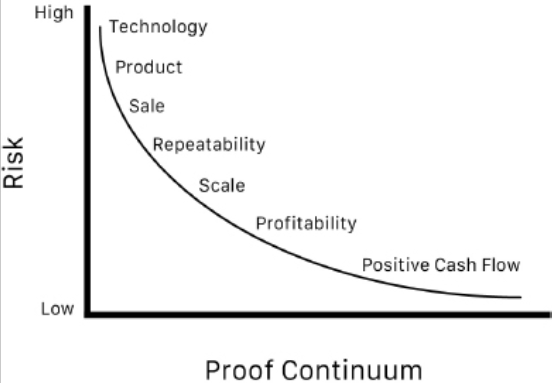
The diagram above shows the level of risk one takes when they invest in a startup, based on the level of maturity the company is at. The early developmental stages are the highest risk, meanwhile having a positive cash flow poses little risk in comparison. Not all companies develop in order of the level or stages of maturity provided, but you can typically evaluate where a company lies based on their proof level. The author points out that no two companies are the same, even if they are on the same stage of the Proof Continuum. While not all proofs may be obvious to the untrained eye, you can see hints about where they could lie by assessing what types of positions they have/are looking for, see their reviews on their website, look at industry reports, etc.
I think the Proof of Continuum is a great tool for investors and the company board/leadership team to assess where they stand and how they can still improve to become more successful. These stages are easy ways for the company to set goals and see where they may need to improve their skills to become even more successful.
I hope you enjoyed this week’s reflection, and stay tuned for next week’s post! Next week, I’ll be focusing on Part 2 of the book “Should you work at a start-up?”
Resources:
- Bessalel, Gus. The Startup Lottery: Your Guide to Navigating Risk and Reward. Jones Media Publishing, 2023, p. 38. ↩︎
- Bessalel, Gus. The Startup Lottery: Your Guide to Navigating Risk and Reward. Jones Media Publishing, 2023, p. 30. ↩︎
- Bessalel, Gus. The Startup Lottery: Your Guide to Navigating Risk and Reward. Jones Media Publishing, 2023. Exhibit 3-2, p. 33. ↩︎


 Explore Entrepreneurship & Innovation
Hi Meaghan,
This was a great overview of the Proof Continuum—thank you for breaking it down in such a practical way. I especially appreciated your question at the end: How can we really know where a startup sits on the success/risk scale just by looking at those proofs? That’s such a relevant concern, and one I think about a lot in my own work in the grants department.
While we deal with public or philanthropic funding rather than venture capital, the same principle applies: we need to assess the maturity and capacity of partner organizations before allocating resources. The Proof Continuum offers a helpful lens for that kind of evaluation—even if the context is different. For example, when reviewing grant applications, I often look for signs of “proof of repeatability” or “proof of scale,” even if those terms aren’t explicitly used. Are the outcomes replicable? Is the organization building systems and processes that show they can deliver consistent results? Have they moved past pilot phases into broader implementation?
I also really liked the point that no two companies—even at the same stage—look exactly alike. In the nonprofit and public sector, the nuances in leadership, funding mix, and organizational culture can dramatically affect how well a group advances from one “proof” to the next. Just as with startups, it’s not always linear. The ability to pivot, learn from data, and stay agile plays a huge role in long-term success.
And your mention of the diagram helping everything click—that resonates too. Visualizing the risk/reward curve across stages makes it much easier to understand why certain milestones matter more than others. It’s not just about progress—it’s about predictability and sustainability.
Thanks for the great reflection. This tool has given me a new way to think about how we assess program partners, especially when they’re in early development stages but show high potential. Looking forward to your next post on whether working at a startup is the right fit—should be an interesting follow-up!
LikeLike
Thank you for your feedback Freddy!
I love that you used public and nonprofit businesses as your example for two businesses looking different when they’re at the same stage on the continuum. I had personally never given much thought about this until I switched from working in the private sector to the public sector in higher education. It has opened my eyes to a new way of doing things than what I learned in school simply because of the different hoops you have to go through.
I am so glad to hear that this is a tool you can apply to your work even if it’s not explicitly stated. I have found myself comparing things at my job to the overall principle of the continuum and have spent far too much time telling others about it!
I was recently tasked with helping to find a new Project Management Director to help our PM team and processes mature, the whole time I kept asking how am I supposed to know what that means not being in the PM world at all. Had I known a tool like this was out there, I feel like it could have helped me access where team currently is and where we’d like to be more efficiently.
LikeLike
Meaghan, this was such a clear and thoughtful breakdown of the Proof Continuum. I really appreciated how you walked through each stage and then asked the key question: how do we actually assess where a startup sits on the risk/success scale? That’s a real challenge—especially when so much of this depends on nuance, timing, and behind-the-scenes factors that aren’t always visible.
Your reflection helped me think about how this framework could apply not only to startups but also to internal projects and teams in larger organizations. The example you gave about hiring a Project Management Director really brought that home. Even if we’re not dealing with external investors, being able to gauge maturity, scalability, and repeatability is incredibly useful when planning growth, allocating resources, or making key hires.
I also liked your point about no two companies—or even departments—looking the same at the same stage. It reminds me that leadership, culture, and context all shape how a team moves through these milestones. The Proof Continuum gives structure, but it’s our insight and experience that help us read between the lines.
You’ve done a great job turning this into a practical tool, and your excitement is contagious. Looking forward to your next post—especially your thoughts on whether working at a startup is a good fit!
Warm regards,
Brent Parker
Owner – Resilience Repurposed LLC
Graduate Student – WCU (M.E.I.L.E. Program)
https://blog.resiliencerepurposed.com
LikeLike
Hi Brent,
I am so glad to hear you appreciated this post and found it useful! I have found since reading this chapter that I can apply this method to a lot of projects and tasks. It reminds me of one of your recent posts about the milestone stages, I think points like this could stand as good cues to check in and see where everyone is at on a project.
With our recent Chart of Accounts project, I feel like a tool like this could also be helpful in the sense of planning and seeing what budgets look like at each stage on the continuum.
Thank you for commenting!
LikeLike
Meaghan,
What a great tool to use to help see the reality of where a start up is in the process. I am a very visual person and so I get more out of content when I read it and see it displayed visually as opposed to just reading about it. I like how each of these “proofs” are broken down described to get a better understanding of what they really mean.
I appreciate the point brought out that this diagram isn’t set in stone and uniform for all ventures/not all will “develop in order of the level or stages of maturity” and that no matter if two ventures are at the exact same spot on the continuum, no two companies are the same. I could see where are all kinds of outside factors that could affect the business at a particular stage in which they could go backwards and forwards on the continuum, whether it be market demand changes from competitor products being developed or something like an interruption in funding available.
Thank you for introducing this continuum in your book reflection. I might compare it to something like a bank account. Reviewing your bank account helps you because you need to know where you stand in order to know where you need to go next. Knowing where you fall on the continuum, can help you streamline your efforts going forward.
LikeLike
The above comment was from Jenny Griffin.
LikeLike
Hi Jenny,
I am also a visual person so as soon as I saw this chapter had a visual element I made it a point to include this! I’m glad to hear that it was a better way for you to digest the information as well.
When I was reading this chapter, I felt like I kept having to go back and forth between sections to get a ‘definition’ of each stage. While some of the names are synonymous with their meaning, others weren’t as clear of an explanation so I thought it would be helpful to have in one spot!
I appreciate you bringing a new example of how to use the continuum, I hadn’t thought of it in the sense of a bank account but I like that example! I’ll have to keep that in mind.
Thank you for commenting on this post, I appreciate it!
LikeLike